Heritage & bilingual
Mandarin at Home: How Bilingual Families Keep Chinese Going Every Day
Mandarin at home for bilingual families is not about recreating a Chinese classroom inside the house. It is about building the small, daily habits that keep a child's relationship with Chinese alive and growing — through real conversations, familiar routines and meaningful things to make and say. This guide looks at how bilingual families with children aged 5 to 12 can keep Mandarin going every day, without turning home into a school and without needing one parent to be a fluent Mandarin speaker.
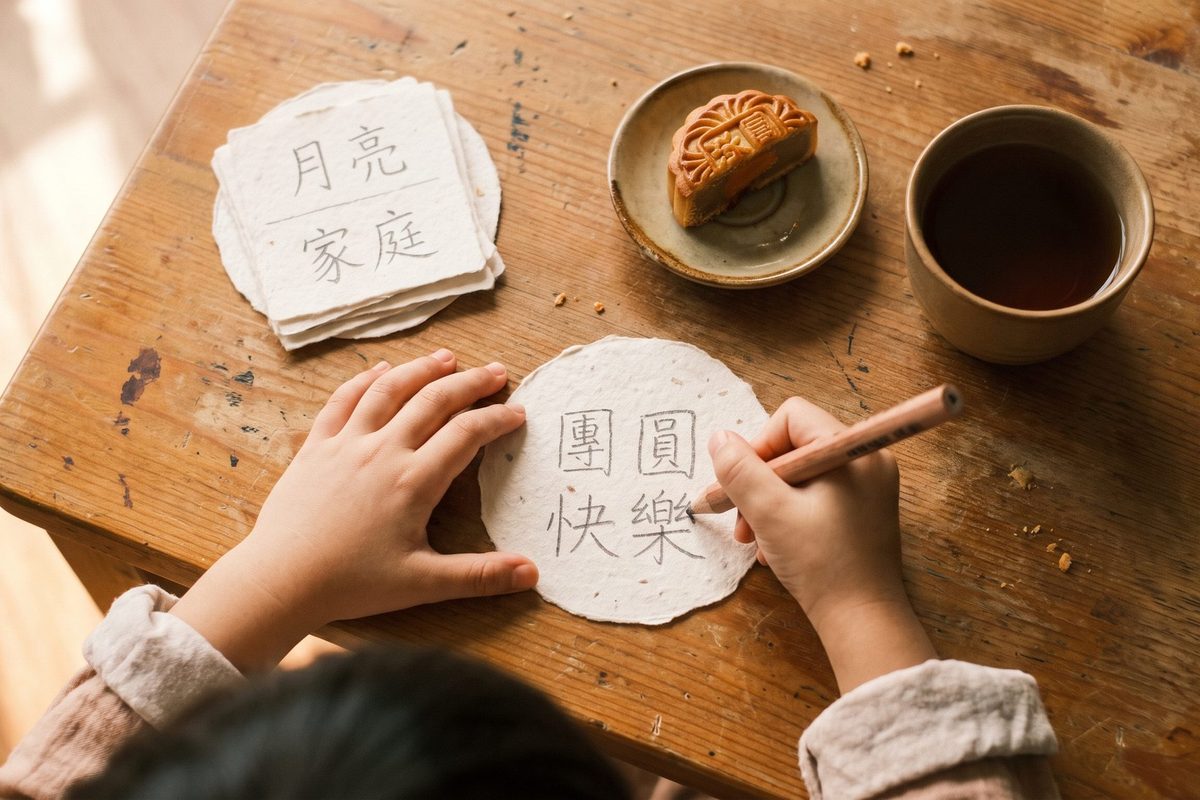
For bilingual families raising children between English and Mandarin, home is the front line of language maintenance. School is in English. The playground is in English. Sport, music, friends — all English. The home is usually the only space where Mandarin can exist in a natural, unhurried way. How that space is used makes an enormous difference to whether a child aged 5 to 12 grows up genuinely bilingual or whether Chinese fades quietly into the background over the primary school years.
Key takeaways
Mandarin at home for bilingual families works through consistent daily habits, not intensive weekly sessions; the cumulative effect of small regular moments is what builds a bilingual child.
The most effective approach integrates Mandarin into existing routines — meals, bedtime, greetings — rather than adding a separate "Chinese time" that competes with everything else.
Children who have things to make and say in Chinese — letters to grandparents, labelled drawings, food names they know — develop a sense that Chinese is theirs to use, not just to practise.
The physical environment matters: Chinese books, characters on the wall and bilingual materials visible at home all contribute to making Mandarin feel like a normal part of the household.
Resistance and reluctance are normal phases; how a family responds to them — with flexibility rather than pressure — determines whether the child comes back to Mandarin willingly.
What Mandarin at home actually means
Mandarin at home for bilingual families is often confused with two things it is not. It is not immersion — that would require both parents to speak only Mandarin all day, which is neither possible nor desirable for most bilingual families. And it is not a formal language programme — that would mean structured lessons, drills and homework, which turns Chinese into a subject rather than a family language.
What Mandarin at home actually means is simpler and more sustainable: Mandarin is present, normal and emotionally warm in specific daily contexts. A child who grows up hearing 吃飯了 (chī fàn le, time to eat) every evening, saying 晚安 (wǎn'ān, goodnight) before bed and using Chinese words for the foods they know has a living relationship with the language. That relationship is not dependent on formal instruction — it is built through daily life.
The key insight from research on bilingual families is that it is consistency and emotional warmth, not volume, that determines whether a minority language thrives at home. A child who hears Mandarin reliably in a few emotionally significant contexts will maintain it better than a child who receives intensive exposure that then disappears or becomes associated with pressure.
Daily routines: the most reliable Mandarin moments
For bilingual families, the daily routine is the most reliable source of Mandarin input because it happens regardless of how busy or tired the family is. The key is to identify two or three routine moments and commit to using Mandarin in those moments consistently.
Mealtimes
Mealtimes are exceptionally well suited to Mandarin at home because they are daily, emotionally warm and naturally full of vocabulary that most heritage children already have some exposure to. Food names, descriptions of taste and texture, questions about the day — all of this can happen in Mandarin around the dinner table.
Useful phrases for mealtime Mandarin include: 好吃嗎 (hǎo chī ma, does it taste good?), 再吃一點 (zài chī yīdiǎn, have a bit more), 喝湯 (hē tāng, drink your soup), 吃完了 (chī wán le, finished eating). Children who hear these phrases every evening at dinner learn them without effort — they simply absorb them through repetition and context.
Using Chinese names for foods consistently is one of the highest-return habits a bilingual family can adopt. A child who calls rice 飯 (fàn), soup 湯 (tāng) and dumplings 餃子 (jiǎozi) develops bilingual word associations for these foods that run deeper than vocabulary drills. The words are attached to real taste, smell and the experience of eating together.
Bedtime
Bedtime is a natural Mandarin moment for bilingual families because it is quiet, intimate and predictable. A short Chinese-language picture book or story at bedtime, a few consistent phrases (晚安, wǎn'ān; 我愛你, wǒ ài nǐ), and the gentle repetition of the same words night after night create a durable and emotionally warm Chinese anchor for a child aged 5 to 12.
Parents who are not fully fluent in Mandarin can read Chinese-language picture books slowly, using a bilingual edition or a translation alongside the Chinese if needed. The goal is not perfect fluency — it is regular exposure to the sounds and rhythms of the language in a trusted, comfortable setting. Children who have been read to in Chinese at bedtime for years develop a deep familiarity with the language that shows up later in their reading and speaking confidence.
Greetings and transitions
The moments when family members come and go — arriving home, leaving for school, waking up in the morning — are brief but frequent, and they offer natural Mandarin moments for bilingual families. 早安 (zǎo'ān, good morning), 回家了 (huí jiā le, we're home), 再見 (zàijiàn, goodbye), 今天好嗎 (jīntiān hǎo ma, how was today?) — these phrases happen multiple times a day, every day, and their cumulative effect over a childhood is significant.
Conversations that work: asking questions in Mandarin
Many bilingual families discover that the most sustainable Mandarin conversations at home are asymmetric: the parent asks in Mandarin, and the child is allowed to answer in either language. This approach reduces the pressure that drives most resistance, while still exposing the child to natural Mandarin speech and keeping the conversation genuinely interactive.
Useful question patterns for Mandarin at home include:
Chinese | Pinyin | English |
|---|---|---|
你今天做了什麼? | Nǐ jīntiān zuò le shénme? | What did you do today? |
你吃飽了嗎? | Nǐ chī bǎo le ma? | Are you full? |
你喜歡嗎? | Nǐ xǐhuān ma? | Do you like it? |
你在想什麼? | Nǐ zài xiǎng shénme? | What are you thinking about? |
告訴我。 | Gàosu wǒ. | Tell me. |
The asymmetric approach — Mandarin question, any-language answer — works because it keeps communication genuinely open. A child who cannot or will not answer in Mandarin can still have a real conversation, which keeps the experience positive and keeps the child connected to the Chinese being spoken around them. Over time, as the child's vocabulary and confidence grow, more of their answers will naturally shift toward Mandarin.
The physical environment: making Chinese visible at home
Mandarin at home for bilingual families is not only about spoken language — it is also about what the child sees. A home where Chinese characters appear naturally in the environment sends a continuous signal that Chinese is a normal part of this family's life.
Practical ways to make Chinese visible:
Labels on household objects. Labelling common objects — 冰箱 (bīngxiāng, refrigerator), 門 (mén, door), 窗戶 (chuānghù, window), 桌子 (zhuōzi, table) — alongside their English labels creates bilingual associations over time. Children who grow up seeing Chinese characters next to everyday objects develop a naturalness with the script that is very difficult to replicate through deliberate study later.
Chinese books on the shelf. A bookshelf with Chinese-language picture books, bilingual editions and simple readers signals that Chinese is a reading language in this home. When a child can reach for a Chinese book as naturally as an English one, the language is normalised in a fundamental way.
Calendars, prints and posters in Chinese. A Chinese-language calendar on the kitchen wall, a print of Chinese characters with their meanings, or a traditional festival decoration with Chinese text all keep the script visible in a low-key, decorative way. These are not study materials — they are environment.
Family photos with Chinese captions. A family photo labelled with Chinese names and relationships — 爸爸, 媽媽, 外婆, 哥哥 — is a visual anchor for family vocabulary. A child who sees their own family described in Chinese develops a personal connection to those characters that abstract vocabulary lists cannot create.
Making something: active use of Chinese at home
Children who only receive Chinese input — listening, watching — stay passive. The habits that build a genuinely bilingual child include regular opportunities to produce Chinese: to say something, write something, make something in Chinese that has real purpose and real recipients.
Letters and messages to grandparents
Writing a short message in Chinese to Mandarin-speaking grandparents or relatives — even just 我愛你 (wǒ ài nǐ, I love you) and a drawing for a younger child, or a few sentences describing what they did that week for an older child — gives the child a real reason to use Chinese. The grandparent's response, in Mandarin, creates a genuine exchange that motivates further effort far more reliably than assigned practice.
Cooking with Chinese
Cooking traditional Taiwanese or Chinese dishes together is a natural opportunity to use Mandarin at home. The names of ingredients, steps in the recipe, descriptions of textures and tastes — all arrive in a context where the language is inseparable from the activity. A child who makes 湯圓 (tāngyuán) for 冬至 (dōngzhì, Winter Solstice) with a Mandarin-speaking parent absorbs the vocabulary through doing rather than through study.
Labelled drawings and artwork
Children aged 5 to 8 who enjoy drawing can be encouraged to add Chinese labels to their pictures: the name of a character, a colour word, the name of a food or animal. A drawing labelled 貓 (māo, cat), 紅色 (hóngsè, red) or 蘋果 (píngguǒ, apple) gives the child an active relationship with the characters they are learning. The drawing belongs to them; so do the Chinese words on it.
Festive preparations
Traditional Taiwan festivals — 中秋節 (Zhōngqiū jié, Mid-Autumn Festival), 農曆新年 (Nónglì xīnnián, Lunar New Year), 端午節 (Duānwǔ jié, Dragon Boat Festival) — are natural occasions for Chinese to be spoken and made at home. Making decorations, preparing festival foods, writing festival greetings in Chinese — these are the kinds of activities where language learning and family life become the same thing.
If you are helping a child aged 5 to 12 build Mandarin at home, Coachers.org teaches Chinese through Taiwan stories to children aged 5 to 12. Its online courses use videos, worksheets and vocabulary and sentence cards built around five themes — Home, Family, Food, Place and Feelings — that fit naturally into the daily life of a bilingual family, and each unit ends with something the child makes: a card, a creative project, a piece of writing for family.
Handling the "I don't want to" moments
Every bilingual family raising children between Mandarin and English will face resistance at some point. A child who was happy to speak Chinese at five may resist at eight. A child who loved Chinese picture books may suddenly prefer English ones. A child who spoke Mandarin freely with grandparents may start answering in English. This is normal, and how a family responds to it matters enormously.
Do not meet resistance with more pressure
The reflex of many parents when a child resists Mandarin is to increase the pressure: insist on Chinese responses, schedule more Chinese time, express disappointment. This almost always makes the resistance stronger. The child's resistance is usually a signal that the current approach has become associated with pressure, obligation or inadequacy — none of which motivate language learning.
Return to low-pressure contexts
When a child resists, the most effective response is to reduce the demands and return to the contexts where Mandarin has historically felt comfortable: a favourite story in Chinese, a video call with a grandparent the child loves, a meal with Chinese food names. The goal is to restore the positive emotional association with the language, not to maintain a production level the child is not currently willing to sustain.
Find the motivation inside the child, not outside
Children who maintain Chinese willingly over the long term are those who understand — in a felt, not just intellectual, sense — why it matters to them personally. Not why it matters to their parents, but why it matters to them. This understanding comes slowly, through accumulated experience: the grandparent who lights up when they hear you speak Chinese, the visit to Taiwan where the language suddenly made sense, the story that felt like it belonged to their own life. Parents can create the conditions for these experiences; they cannot force the realisation.
A sustainable weekly approach for bilingual families
For bilingual families who want a simple, sustainable approach to Mandarin at home, the following structure covers the essential bases without overwhelming the family's existing routine:
Moment | What to do in Mandarin | How often |
|---|---|---|
Mealtime | Food names, simple questions, greetings | Daily |
Bedtime | One Chinese-language story; goodnight phrases | Daily or most nights |
Family call | Video call with Mandarin-speaking relatives | Once or twice a week |
Making something | Drawing, card, festival preparation in Chinese | Once a week |
Story or content | Chinese-language picture book, story or audio | Two or three times a week |
This schedule requires no dedicated "Chinese time" and adds no extra activities to an already full week. It simply means choosing Mandarin in moments that already exist: meals, bedtime, calls and the occasional creative activity. Over months and years, those moments accumulate into a genuinely bilingual childhood.
FAQ
How do bilingual families keep Mandarin going at home when both parents are busy?
The families who succeed tend to build Mandarin into existing routines rather than adding separate Mandarin time. Using Chinese at mealtimes, during the bedtime routine and in greetings costs no extra time — it replaces English in moments that happen anyway. Five consistent daily moments add up to thirty to forty minutes of Mandarin exposure, which is a meaningful amount for a child aged 5 to 12 outside a Chinese-speaking country.
What if my child refuses to speak Mandarin at home?
Refusal usually signals either pressure or a gap between what the child is asked to produce and what they can actually manage. The most effective response is to reduce the pressure: stop insisting on Chinese-only exchanges and return to contexts where the child already feels comfortable with Mandarin — the words they know, the phrases they hear every day. Gradually rebuild from there. Resistance that is met with flexibility almost always softens; resistance met with more pressure almost always hardens.
Should bilingual families keep Mandarin and English strictly separate at home?
Strict separation — one parent always speaks only Mandarin, one always speaks only English — works well for some families, but it is not the only effective approach. Many successful bilingual families use a more fluid approach: Mandarin in specific contexts (mealtimes, bedtime, conversations with grandparents), English in others. What matters most is that Mandarin is used consistently in predictable, emotionally warm contexts, not that it is enforced in every interaction.
How much Mandarin does a child need to hear at home to stay bilingual?
Research on bilingual development suggests that consistent, meaningful exposure to a minority language in the home is more important than the total volume of hours. A child who hears Mandarin reliably in predictable, valued contexts — mealtimes, stories, family calls — tends to maintain and develop the language better than a child who receives occasional intensive exposure. Regular contact over years, even at modest levels, is more effective than sporadic intensive effort.