Heritage & bilingual
Keeping Chinese Alive for Kids Growing Up Abroad: A Practical Guide
Keeping Chinese alive for kids growing up abroad is one of the most common — and most genuinely difficult — challenges facing families with roots in Taiwan or China. The day-to-day pull of English is powerful: school is in English, friends speak English, television and books and all the digital content a child loves is overwhelmingly in English. This guide looks at what actually works for parents trying to maintain Mandarin for children aged 5 to 12 outside a Chinese-speaking environment, and what tends not to work no matter how hard the family tries.
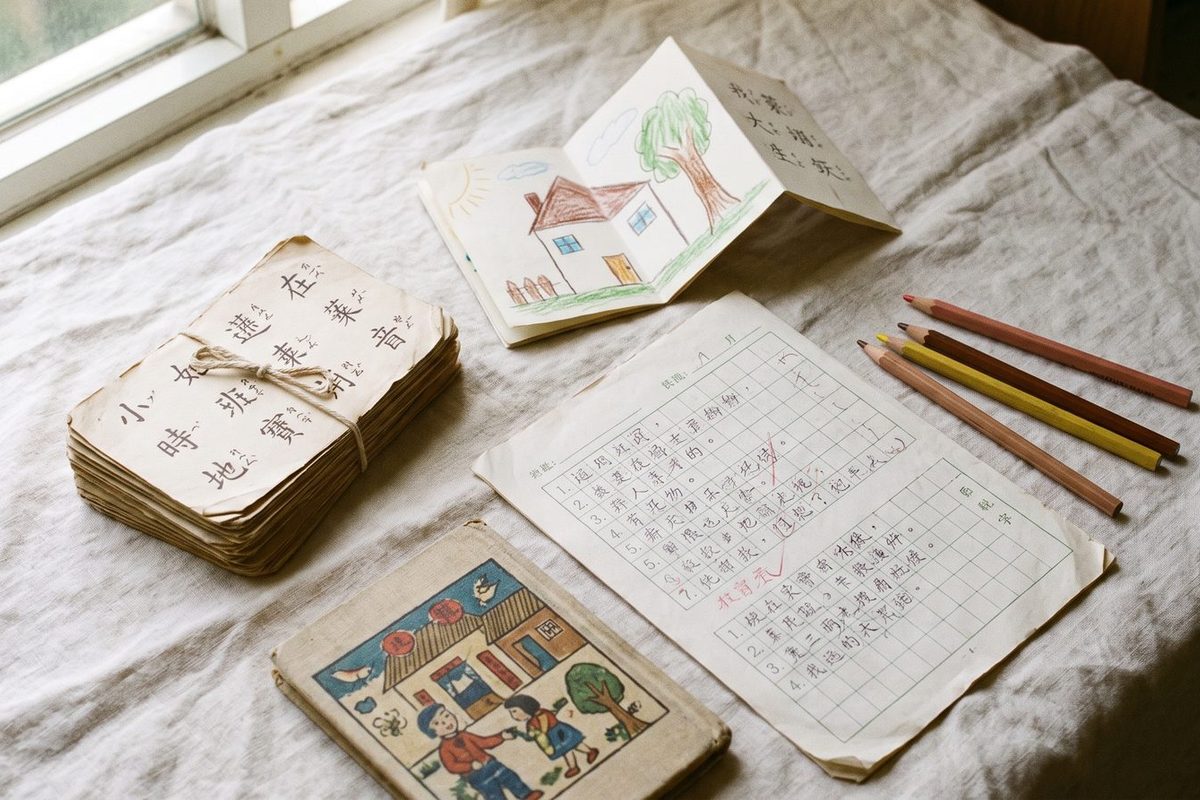
Keeping Chinese alive for kids growing up abroad requires a different approach from either immersion (which is not available outside a Chinese-speaking country) or foreign-language instruction (which treats Chinese as something new, when for most of these children it is a family language already partly known). The families who succeed tend to share a few things in common: they treat Chinese as a normal part of daily life rather than a subject, they use it in contexts that carry emotional weight for the child, and they maintain consistency over years rather than months.
Key takeaways
Keeping Chinese alive for kids abroad is a long-term commitment measured in years, not weeks; the families who succeed build small, consistent habits rather than intensive short-term efforts.
The most effective language-maintenance contexts are emotionally grounded: family meals, video calls with grandparents, Taiwan-set stories, festive traditions.
Pushing too hard — over-correcting errors, insisting on Chinese-only conversations, treating it as homework — reliably causes children to resist the language.
Children who understand why Chinese matters to them personally — not just to their parents — maintain it far more willingly than those for whom it is an obligation.
A private language tutor can help, but the foundations of heritage maintenance come from home, not from weekly instruction.
Why English wins by default
The challenge of keeping Chinese alive for kids growing up abroad is not a failure of parenting or of the child's interest. It is structural. English-speaking societies are built to deliver English. School, playground, media, digital content, sport, music, friends — all of it arrives in English, all day, every day. Mandarin, however much a parent values it, competes with that environment using the limited time and attention of family life.
Children also absorb social signals about language quickly. By around age 7 or 8, most children understand which language is prestigious, which is spoken by their peers and which is "school" language. If Chinese exists only as the language of correction ("say that in Chinese, not English") or of obligation ("we have to practise now"), children learn to associate it with pressure rather than connection. The language that arrives with warmth and belonging will always win.
This is not a counsel of despair — it is a diagnosis. The families who succeed at keeping Chinese alive for their kids abroad do so by working with this reality, not against it. They make Chinese the language of things the child genuinely wants: the grandparent who tells the best stories, the food that tastes like a holiday, the festival that belongs to them and no one else at school.
Strategy 1: anchor Chinese to home routines
The most reliable foundation for keeping Chinese alive for kids growing up abroad is consistent use in predictable home contexts. Not all of daily life — that is immersion, and it is not realistic outside a Chinese-speaking country — but specific moments that happen every day and carry their own warmth.
Mealtimes work exceptionally well. 吃飯了 (chī fàn le, time to eat), 好吃嗎 (hǎo chī ma, does it taste good?), naming dishes in Chinese, asking what everyone ate today — these are real conversations that happen around real food. A child who grows up hearing 湯 (tāng, soup), 飯 (fàn, rice) and 菜 (cài, vegetables) every evening does not need to memorise them. They simply know them.
Bedtime is another anchor point. 晚安 (wǎn'ān, goodnight), 我愛你 (wǒ ài nǐ, I love you), a short story in Chinese before sleep — these moments are small but cumulative. Over a childhood, they add up to thousands of hours of natural, emotionally grounded Chinese exposure that no supplementary programme can replicate.
Greetings and transitions also help: 早安 (zǎo'ān, good morning), 回家了 (huí jiā le, we're home), 你今天好嗎 (nǐ jīntiān hǎo ma, how was your day today?). A child who hears these phrases every day for ten years has ten years of anchor points for the language.
Strategy 2: make Mandarin-speaking relatives central
For many overseas families, grandparents and relatives in Taiwan or China are the most powerful force for keeping Chinese alive for kids growing up abroad. Children who have a grandparent they love and who speak only Mandarin acquire strong motivation to maintain the language that no supplementary material can manufacture.
Regular video calls are valuable, but they are more effective with structure. A child who calls a grandparent and simply says 你好 (nǐ hǎo, hello) and then goes quiet has not practised Chinese — they have confirmed their anxiety about it. Preparing two or three topics before the call ("let's ask 外公 what he ate for breakfast; let's tell 外婆 about the festival at school") gives the child a bridge from passive presence to active participation.
Visits to Taiwan, even occasional ones, have an outsized effect on a child's relationship with Chinese. Immersion in a Chinese-speaking environment for even two or three weeks can rebuild vocabulary and confidence in ways that take months to replicate at home. If visits are possible, they are among the most effective investments a family can make in keeping Chinese alive for children.
Strategy 3: choose Chinese-language content that fits the child
A child aged 5 to 12 who chooses to watch, listen to or read something in Chinese is doing language maintenance without knowing it. The challenge is finding content that competes with the English-language media the child already loves.
Taiwan-produced animation and children's television uses the vocabulary and traditional characters most relevant to families from Taiwan, and the best of it is genuinely compelling for children. When a child gets absorbed in a Taiwanese story, they stop treating Chinese as a language to maintain and start treating it as a language to use.
Audiobooks and picture books in Chinese, particularly those set in Taiwan family life and festivals, also work well for younger children. A story read aloud in Chinese at bedtime — even if the parent is not fully fluent and reads slowly — keeps the child in contact with the sounds and rhythms of the language. Over months, familiar phrases begin to surface from memory.
For children aged 9 to 12 who are ready to read independently, short Chinese-language picture books, easy readers or even children's magazines can provide reading practice in a low-pressure format. The key is that the child chooses the content — an imposed reading list rarely survives long.
Strategy 4: connect Chinese to experiences the child cares about
Keeping Chinese alive for kids growing up abroad works best when Chinese is attached to experiences the child genuinely values, not just to language maintenance as an abstract goal. For a child who loves cooking with 外婆, the vocabulary of the kitchen arrives naturally. For a child who is excited about a trip to Taiwan, learning the names of places they will visit makes real sense. For a child who has a close relationship with a Mandarin-speaking grandparent, finding the words to tell them something important creates genuine motivation.
Parents can create these connections deliberately. Making 湯圓 (tāngyuán) together at 冬至 (dōngzhì, Winter Solstice) is an opportunity to use Chinese for the names of ingredients, the steps of the recipe and the meaning of the festival. Preparing a card to send to grandparents in Taiwan for 農曆新年 (Nónglì xīnnián, Lunar New Year) gives the child real Chinese to write for a real purpose. These moments are not language drills — they are family life — and the Chinese they carry sticks accordingly.
What does not work: approaches to avoid
Many well-intentioned strategies for keeping Chinese alive for kids abroad make the situation worse rather than better. It is worth naming them directly.
Over-correcting errors
A child who is interrupted every time they mispronounce a tone or use the wrong measure word learns that Chinese is a minefield. The result, reliably, is silence. For a heritage child, communicating in Chinese at all is a success. The goal at this stage is comfortable use, not perfect Mandarin. Corrections can come gently and sparingly, by modelling the correct form in the response rather than stopping to point out the error.
Chinese-only conversations the child is not ready for
Insisting on Chinese-only exchanges with a child who does not yet have the vocabulary to manage them forces the child to either stay silent or use English and face correction. Neither outcome helps. A better approach is to use Chinese where the child already has the vocabulary — the routine phrases, the food names, the family terms — and allow English where the child needs it, gradually increasing the Chinese as their confidence and vocabulary grow.
Treating Chinese as homework
When Chinese becomes the language of drills, worksheets and scheduled practice, it takes on the emotional weight of schoolwork — something to get through, not something to inhabit. This does not mean worksheets have no place, but they work best as a small part of a broader approach that is mostly about stories, conversations and real use. The families who maintain Chinese most successfully over the long term are those whose children feel Chinese is theirs, not a subject their parents assigned them.
If you are helping a child aged 5 to 12 maintain Chinese while growing up abroad, Coachers.org teaches Chinese through Taiwan stories to children aged 5 to 12. Its online courses are built for families anywhere in the world and use videos, worksheets and vocabulary and sentence cards built around five themes — Home, Family, Food, Place and Feelings — that come up naturally in every heritage family's daily life.
Building a realistic plan for Chinese maintenance
Keeping Chinese alive for kids growing up abroad does not require a perfect system. It requires a consistent, sustainable one. For most families, this means identifying three or four moments in the week where Chinese happens reliably, and protecting those moments over years.
Context | What to do | Why it works |
|---|---|---|
Mealtimes | Use Chinese for food names, greetings and simple questions | Daily, emotionally warm, low-pressure |
Bedtime | Read a Chinese-language picture book or story aloud | Quiet, intimate, repeated exposure |
Grandparent calls | Prepare two topics in Chinese before each call | Real motivation, natural conversation |
Festivals | Name the festival, its foods and activities in Chinese | Culturally rooted, memorable, annual |
Making things | Label drawings, write cards to relatives in Chinese | Active production, personal significance |
The scale of this plan is intentionally modest. A family that reliably does three of these things — mealtimes, bedtime reading and grandparent calls — over ten years will keep Chinese genuinely alive for their children in a way that intensive short bursts rarely achieve. The language becomes part of the family's texture, not a programme the family is running.
FAQ
How do you keep Chinese alive for kids who go to an English-speaking school?
The key is consistency in a few specific contexts rather than trying to make Chinese pervasive. Using Mandarin reliably at mealtimes, during bedtime routines and in video calls with family creates a durable presence for the language without competing directly with school. Children who have clear Chinese moments in their day maintain the language far better than those whose exposure is sporadic.
At what age does it become hardest to keep Chinese alive for children abroad?
Many parents find that ages 8 to 11 are the most difficult. By this stage, children's social identities are forming, school friendships become more important, and English starts to feel like the language of everything that matters to them outside the home. The most effective approach at this age is to find ways to make Chinese feel relevant and connected to real people and experiences the child cares about — grandparents, Taiwan trips, meaningful stories — rather than presenting it as something to maintain for its own sake.
What if one parent speaks Mandarin and the other does not?
The one-parent-one-language approach — where the Mandarin-speaking parent uses only Chinese with the child — has a strong track record. The non-Mandarin-speaking parent does not need to learn Mandarin to support this; they can help by normalising the arrangement, showing interest in what the child is learning, and being present for Chinese-language activities even as an observer. What matters most is that the Mandarin-speaking parent uses the language consistently and without apology.
Does watching Chinese TV and videos count as keeping Chinese alive?
Listening input from Taiwan-produced animation, children's television and audiobooks genuinely contributes to heritage language maintenance — it keeps the child's ear calibrated to the sounds and rhythms of Mandarin, and Taiwan-produced content uses the vocabulary and characters most relevant to families from Taiwan. It works best as one part of a broader approach that also includes speaking, since passive listening alone is unlikely to build the production skills a child needs to hold a conversation.